
Council of Islamic Ideology has no authority to rule on criminal liability: IHC
Intelligence report synthesized for precision. Verified source updates below.
Detailed Report
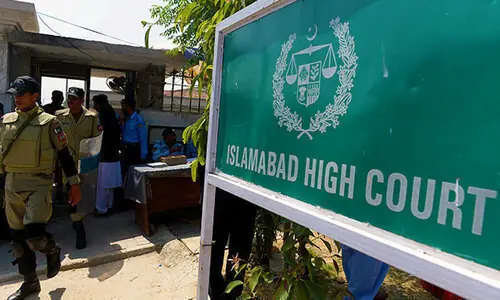
ISLAMABAD: In a landmark verdict, the Islamabad High Court (IHC) has ruled that the Council of Islamic Ideology (CII) has no legal authority to issue opinions on the criminal culpability of individuals.
In a detailed order written prior to his transfer to the Lahore High Court, Justice Mohsin Akhtar Kayani declared the CII’s 2025 opinion, which labelled cleric-turned-YouTuber Engineer Muhammad Ali Mirza a blasphemer, as “illegal, without lawful authority, and null and void”.
The court held that the constitutional body had grossly overstepped its mandate by entertaining a reference from the National Cyber Crime Investigation Agency (NCCIA) against him.
The judgement stressed that under Articles 229 and 230 of the Constitution, the CII’s advisory jurisdiction is strictly limited to providing guidance to the president, the governor, parliament, and the provincial assemblies — not to courts or investigative agencies.
“The council is not a fact-finding or judicial forum, nor is it its role to determine the criminal liability of an individual, as this authority lies solely with the courts,” the order stated.
Justice Kayani further ruled that by issuing an opinion on a pending criminal matter, the CII had violated the accused’s fundamental right to a fair trial, as guaranteed under Article 10-A of the Constitution.
The controversy arose after the NCCIA, which was investigating a blasphemy case registered against Engineer Mirza under Section 295-C of the Pakistan Penal Code and Section 11 of the Prevention of Electronic Crimes Act (Peca) 2016, sought the CII’s “scholarly opinion” on a YouTube statement that was the subject of the FIR. Relying on the Council’s advisory opinion, the agency included it in the investigation record.
The petition against the CII’s intervention was filed by Dr Aslam Khaki, who argued that the Council had exceeded its lawful authority.
During the hearings, Additional Attorney General Usman Ghuman appeared on behalf of the state, while Advocate Hafiz Muhammad Tahir Ayubi represented Dr Khaki.
While acknowledging the “significant intellectual value” of the Council’s interpretations of the Qur’an and Sunnah, Justice Kayani stated: “Past practices cannot override the clear constitutional limitations imposed by Articles 229 and 230.”
The court noted that investigating agencies may seek independent scholarly opinions for their understanding, but they cannot treat the CII as a de facto court. Such opinions cannot be given legal effect in criminal proceedings.
“If deemed necessary, the federal government or the CII may approach parliament for appropriate amendments to expand the council’s jurisdiction. Until such amendments are made, any exercise beyond the existing constitutional mandate shall remain without lawful authority,” the judgement clarified.
The IHC accepted the writ petition, dealt a blow to the NCCIA’s reliance on the CII’s opinion, and reaffirmed the judiciary’s status as the sole arbiter of an individual’s criminal liability.