CDF Munir says India’s ambitions exceeded its capabilities, armed forces cannot be intimidated
Intelligence report synthesized for precision. Verified source updates below.
Detailed Report
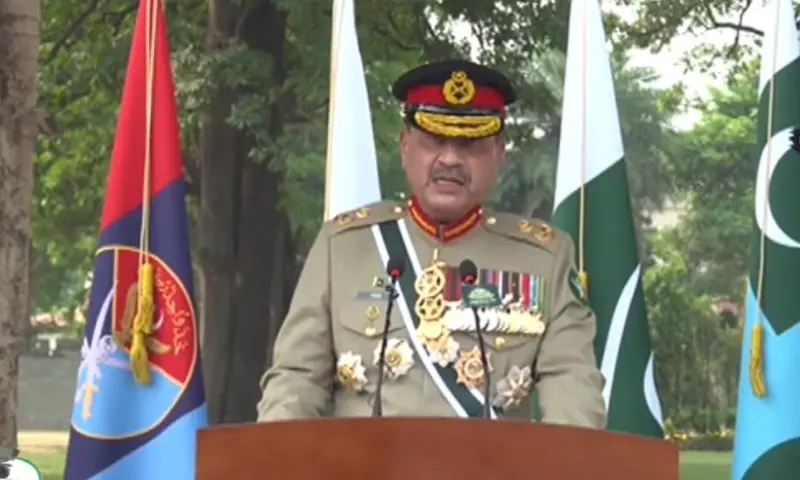
He made the remarks at a ceremony held at General Headquarters (GHQ) in Rawalpindi to mark one year since Pakistan’s victory in last year’s conflict with India.
The conflict with India — starting from the April 22 Pahalgam attack to the end of Operation Bunyanum Marsoos with a ceasefire between the two countries on May 10 — has been called “Marka-i-Haq” (Battle of Truth) by the state.
CDF Munir, as the chief guest, addressed the event. Chief of the Air Staff Air Chief Marshal (ACM) Zaheer Ahmed Babar Sidhu and Chief of the Naval Staff Admiral Naveed Ashraf were also in attendance.
Addressing the ceremony, Field Marshal Munir warned: “Our enemies should know that if any attempt is made in the future to carry out a misadventure against Pakistan, then the impact of war would not be limited, but extremely widespread, dangerous, far-reaching and painful.”
At the outset of his speech, the army chief said the day was a “source of pride” for Pakistan, its public and the armed forces.
He recalled that the “enemy made a failed attempt to test our resolve by violating the sovereignty and territory” of Pakistan from the midnight of May 6/7 till May 10. He asserted this was responded to “with full national unity and military force”.
“Marka-i-Haq was not merely a traditional war fought between two countries or militaries, but in reality, it was a decisive marka (battle) between two ideologies, in which, thanks to Allah, the truth won and falsehood was met with defeat,” he noted.
Quoting a Quranic verse on truth and falsehood, he stressed that the May 2025 conflict was “not a sudden incident, but rather a part of India’s false and widening pattern of exploitative tactics”.
“The false flag operations of 2001, 2008, 2016 and 2019 are a testament that even in the past, India has made failed attempts to impose an illegitimate war on Pakistan and […] achieve narrow-minded, long-term political and military objectives through allegations, exaggeration, warmongering and misleading imagination of limited aggression,” CDF Munir said.
“Each time, not only did Pakistan unveil the wrong estimates of the enemy, but also served it a decisive defeat. In this war as well, India once again was a victim of its obsolete and self-delusional thinking,” he asserted.
The army chief highlighted that the objective of Operation Bunyanum Marsoos was to “unravel the enemy’s behaviour under which, to divert attention from its internal failures, it creates war hysteria by blaming Pakistan for every self-inflicted incident”.
CDF Munir said India was under the false assumption that it could “change the balance of power and prove its dominance over the region by making Pakistan a target of its military aggression and diplomatically isolating it”.
“But in reality, global and defence experts know that India’s ambitions proved to be much larger than its stature and capabilities,” COAS Munir remarked, asserting that Pakistan’s armed forces were not intimidated by the dominance of power and will never do so.
He paid tribute to the martyrs of Marka-i-Haq who “paid the price of this victory with their blood”, including women, the elderly and children killed in Indian strikes.
“All martyrs of Marka-i-Haq and their bereaved families are our crown. Your sacrifices are the guarantor of our independence and everlasting debts,” the army chief said. “We consider our martyrs an amanat, our power a responsibility, and our success a favour of God,” he added.
The army chief proceeded to express his gratitude to the president, the prime minister, the federal cabinet, the national and provincial political leadership, and all political parties for their “everlasting political wisdom, foresight and leadership” that accorded Pakistan success.
“The national leadership, all government institutions and the Pakistani nation gave a message as a single unit that any compromise on the country’s sovereignty, territorial integrity and national honour is unacceptable,” he declared.
CDF Munir stated that Pakistan also “achieved success on the diplomatic front” as its leaders and representatives conveyed Pakistan’s stance on the global stage.
“Similarly, there is no parallel found to the way the Pakistani media, the journalist community, and especially our youth, thwarted the enemy’s propaganda, cyberwarfare and psychological tactics,” he added.
The army chief highlighted that the conflict was not won on just the battlefield, but also “in every section of society” at the national level. Emphasising that a country’s true power lies with its nation’s unity of thought and action, and patriotism, he lauded the “comprehensive national unity” displayed by the public.
“When the clouds of war loomed, we saw that every ideological and individual identity was transformed into Pakistaniyat — labourers, traders, students, the elderly and the young, and all Pakistani men and women resolved to defend their homeland,” he recalled.
“We witnessed a relation between the nation, the government, and the armed forces by virtue of which the entire nation lined up in defence of the country like an iron wall,” the army chief said.
He then recited a Quranic verse from which the phrase “Bunyanum Marsoos” for Pakistan’s retaliatory operation was derived. The verse was also recited earlier during the ceremony.
“In this battle, not only did the armed forces defeat the aggressor enemy beyond its imagination, but the professional expertise and top military strategy of our ground, naval and air forces forced the enemy to meet defeat,” the military chief said.
The CDF commended the air force personnel for “reducing the enemy’s pride to dust and setting the unique example of the modern era’s longest and decisive air battle” under the leadership of the air chief.
“Not only did they down the enemy’s several modern fighter jets, but also destroyed numerous military installations,” he said.
The field marshal also lauded the naval forces for “keeping the enemy’s naval ships thousands of miles away from Pakistani territory through constant monitoring and vigilant defence of the maritime borders”. He further commended the forces on the Working Border and the Line of Control for thwarting India’s aggression and “causing immense loss by destroying its defence positions”.
He asserted that India “suffered great human and economic losses, the price of which it will keep paying in the times to come”.
The army chief recalled that Pakistan “successfully targeted more than 26 military targets” in India during the conflict, following which New Delhi “expressed the wish for a ceasefire” to international powers.
“Defeated India expressed the desire for mediation through the American leadership, which Pakistan accepted in the interest of wider regional peace,” Field Marshal Munir said.
He declared that Pakistan’s “defence was absolutely invincible in the face of any foreign aggression”. “We are strictly committed to maintaining the balance of power in the region and our effective defence deterrence,” he said, asserting that the focal point of the armed forces was the protection of peace rather than aggression.
“And to maintain peace, it is mandatory to be ready for war at all times,” CDF Munir noted.
He observed that traditional wars were a thing of the past, adding that modern and future wars would “comprise multi-domain operations, in which modern technology, including cyber and electronic warfare, drones, long-range vectors, and artificial intelligence would play a crucial role”.
The military chief noted that to “further harmonise Pakistan’s armed forces with multi-domain operations”, the Defence Forces Headquarters has been established, the space programme was being expanded, and the Army Rocket Force Command has been formed.
He cited the induction of Hangor-class submarines in the Pakistan Navy, the acquisition of the “most modern fighter jets” for the Pakistan Air Force (PAF), and the Fatah missile series as “a few examples of this series”.
Prior to the army chief’s address, ACM Sidhu and Admiral Ashraf took turns to lay floral wreaths at the Yadgar-i-Shuhada (Martyrs’ Monument).
A salute was presented by smartly turned-out contingents of the three armed forces, which was followed by the tune of the national anthem played out.
In their messages issued on Saturday, Field Marshal Munir, ACM Sidhu and Admiral Ashraf congratulated the nation and officers and personnel of the armed forces on the completion of one year since the success of Marka-i-Haq.
“Observed with deep reverence, gratitude, and national fervour, the day stands as a testament to the enduring spirit of courage, professionalism, and unity,” a statement issued by the Inter-Services Public Relations (ISPR) quoted them as saying.
“Marka-i-Haq has become a defining landmark in the nation’s journey, reflecting national resolve, military excellence, and strategic maturity. This success not only bolstered national confidence but also established Pakistan as a responsible regional stabiliser, possessing formidable military capabilities,” it stated.
The statement added that Pakistan’s measured and resolute response during Marka-i-Haq “exposed adversarial conspiracies, false flag narratives and disinformation campaigns, diminishing their credibility internationally”.
“Despite facing conventional and hybrid challenges, including proxy terrorism, the armed forces demonstrated superior operational competence across land, air, sea, cyber, and information domains,” it continued.
It further read that in the aftermath of Marka-i-Haq, Pakistan had “further enhanced its defensive capabilities and reinforced full-spectrum deterrence despite resource asymmetries”.