Breathe Pakistan: Envoy notes melting glaciers ‘shared vulnerability’ for countries like Nepal, Pakistan
Intelligence report synthesized for precision. Verified source updates below.
Detailed Report
Despite contributing minimally to global emissions, Pakistan remains among the most climate-vulnerable nations, underscoring the critical need for coordinated, locally grounded, and globally informed responses.
The two-day conference is bringing together policymakers, experts, and stakeholders from across sectors to examine intersecting challenges and chart a path forward.
On the first day, federal ministers, government officials, business leaders, and agriculture and water experts were among the various speakers who presented their perspectives on tackling the climate crisis.
11:40am — Punjab ‘case study’ for rest of world
Marriyum Aurangzeb said that with the provincial government’s interventions, Punjab has become a “case study” in terms of environmental protection for the rest of the world.
“A lot of countries have approached us,” she said, adding that the government was working in collaboration with the “environment sector, legislative lawyers”.
“We have the test policies, test legislation, it is just time to act, bring them together and make them work,” she added.
11:36am — Punjab minister underscores importance of collecting data
The Punjab senior minister underscored the importance of collecting data, saying, “We can’t govern what we can’t measure.
“We have mapped the entire industry, we have mapped the sectors. We have data now available with us and that is being used in our spatial planning,” she added.
11:31am — About 35pc of PM2.5 reduced over past 1.5 years: Punjab minister
Marriyum Aurangzeb speaks at the Breathe Pakistan conference. — White Star/Tanveer Shahzad Marriyum Aurangzeb mentioned various steps and initiatives being undertaken by the Punjab government, including a smog mitigation plan.
She said, “With all what we have done in a year and a half or two years, about 35 per cent of PM2.5, according to the international website, we have reduced over the last year and a half.
“So whatever we are doing seems to be working and having an impact, but a lot needs to be done, of course, in other areas and sectors also,” the minister acknowledged.
Aurangzeb said that the launch of a climate observatory was also being planned, which would have satellite offices across Punjab.
11:20am — Environmental protection, urbanisation not opposing forces: Marriyum Aurangzeb
Marriyum Aurangzeb speaks at the Breathe Pakistan conference. — White Star/Tanveer Shahzad Punjab Senior Minister Marriyum Aurangzeb spoke of Punjab’s actions on moving from “a vulnerable province to more of an environment, climate-resilience leadership”.
Aurangzeb said she did not see environmental protection and urbanisation as opposing forces.
She maintained that if the decision-making takes into account the protection of ecological balance, climate resilience, and infrastructure, “urbanisation can be made inclusive, sustainable and responsible”.
She emphasised that Punjab had taken a “more of an ecosystem approach”, using a multisectoral lens.
The minister mentioned the launch of public buses and the environment protection force as some of the steps to transition towards an environment-friendly urban city.
11:12am — Climate crisis demands solidarity: Maldives’ envoy to Pakistan
The Maldives’ high commissioner called on the Global South to go beyond negotiations and focus on sharing knowledge, technical cooperation and capacity-building.
“Climate crisis demands not only urgency, but solidarity,” he emphasised, affirming that the Maldives remained committed to working with Pakistan and the Global South on the issue.
11:09am — Maldives, Pakistan ‘stand on the frontline of climate vulnerability’
Mohamed Thoha, High Commissioner of the Maldives to Pakistan, speaks at the Breathe Pakistan conference. — White Star/Tanveer Shahzad Mohamed Thoha, High Commissioner of the Maldives to Pakistan, spoke about climate challenges faced by his country.
“Both our countries are different in geography and scale, but we have to stand on the frontline of climate vulnerability,” he said.
Thoha explained that Maldives faced rising sea levels and coastal erosion, threatening long-term sustainability. He added that the Maldives was committed to transitioning 33pc of its energy consumption to sustainable and clean resources.
10:58am — Melting glaciers ‘shared vulnerability’ for countries like Nepal and Pakistan: envoy
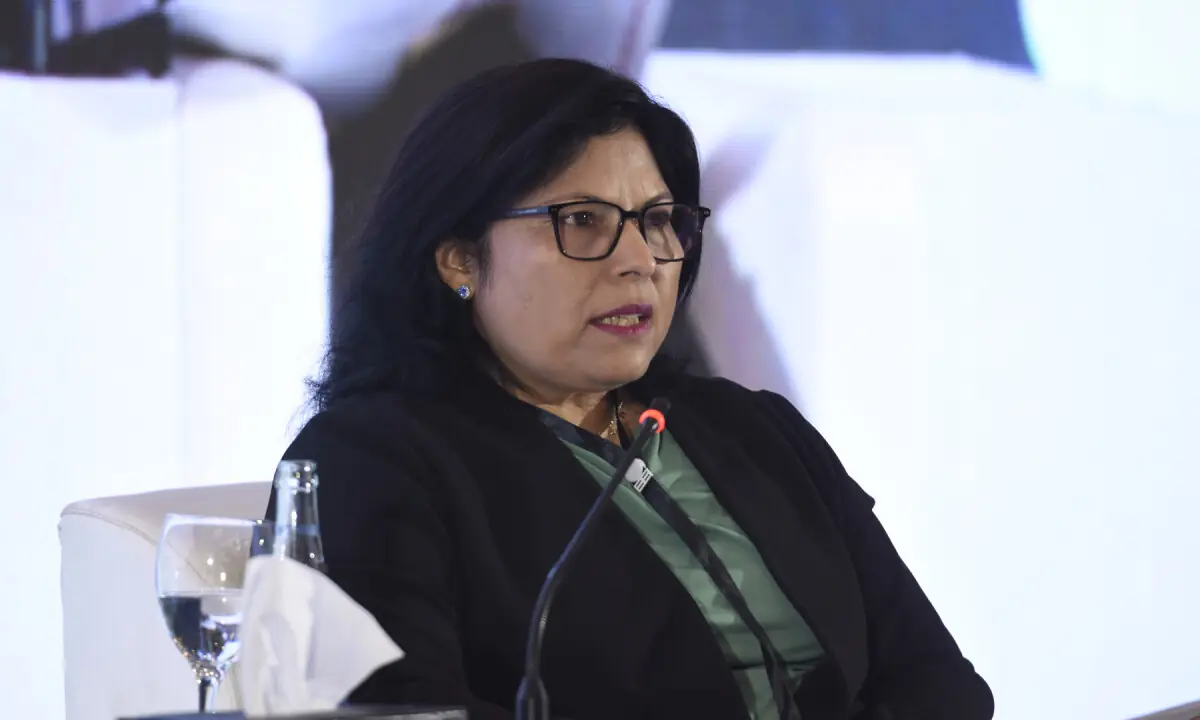
Rita Dhital, Ambassador of Nepal to Pakistan, speaks at the Breathe Pakistan conference. — White Star/Tanveer Shahzad Rita Dhital, Ambassador of Nepal to Pakistan, noted that melting glaciers were a “shared vulnerability” for countries like Nepal and Pakistan.
She highlighted that Glofs hampered tourism, agriculture and hydropower generation in Nepal, recalling that her country has experienced “major Glofs” since 1970s that resulted in significant loss of lives.
Dhital spoke about Nepal’s actions to tackle glacial melting, including using engineering to lower lake levels and identify lakes that pose a potential threat of outbursts.
10:51am — Opportunities lie in Global South: private sector adviser
Seed Advisory Group Principal Seema A. Khan, speaks at the Breathe Pakistan conference. — White Star/Tanveer Shahzad Seed Advisory Group Principal Seema A. Khan, speaking about the private sector’s role, explained the concept of “patient capital”.
She highlighted that it was the Global South where opportunities were present.
“Patient capital is in negotiations with the people who are around this group to discuss where the intersection is between money, policy and national development, because that’s the most profitable,” she said.
“One of the areas that I have found to create the most resilience is the evolution of sovereign capital to look at all of these resources as ways to create banks that then benefit the people,” Khan further said.
10:38am — Romina Alam notes ‘nothing happened’ on Loss and Damage Fund
Romina Khurshid Alam speaks at the Breathe Pakistan conference. — White Star/Tanveer Shahzad “What about the Loss and Damage Fund? Where is that fund? Nothing happened,” Romina Khurshid Alam pointed out.
She called for everyone to work together, including the development and private sectors.
“Justice is right now very much important, but more important is survival,” the PM’s coordinator said.
“No blame, no shame. Just take action,” she said.
10:31am — PM’s coordinator highlights need for ‘regional solution’
Romina Khurshid Alam, coordinator to the Prime Minister on climate change, stressed the need for a “regional solution” rather than a global one, as every region had its different issues.
“This region is suffering. Our children are suffering. We are not in the state of crisis. We are in the state of war from climate change,” she said.
“The developing countries’ people are resilient nations. If you talk about Pakistan, we have proved in the floods that we are not looking for aid; we are looking for trade because this is not something we created.”
10:20am — Goal is to advance resilience in development: climate expert
Renato Redentor Constantino at the Breathe Pakistan conference. — White Star/Tanveer Shahzad Renato Redentor Constantino, international policy adviser at Climate Vulnerable Forum, noted that many people think of climate change as an environmental issue but “we are in the middle of a development crisis”.
He stressed, “Our goal is not to reduce emissions, per se. Our goal is to advance resilience in development.”
10:08am - Expert highlights concept of ethical leverage
Dr Erum Sattar speaks at the Breathe Pakistan conference. — White Star/Tanveer Shahzad Dr Erum Sattar, a water law and policy expert, said, “Pakistan sits where the transboundary water-sharing is very, very complex. There is India in the East and the Kabul River.”
She said that Pakistan sat at the intersection of complexities that affected many nations. She also referred to the concept of ethical leverage.
“Pakistan can experiment at all of these scales,” she said.
10:06am - UN official says Pakistan’s experience not unique
Mohamed Yahya speaks at the Breathe Pakistan conference. — White Star/Tanveer Shahzad Mohamed Yahya, the UN Resident and Humanitarian Coordinator in Pakistan, said,” Pakistan’s reality is unmistakable; from floods to prolonged droughts to glacial melts. This experience is not unique to Pakistan. It reflects a reality across South Asia.”
He said that the panel’s discussion would be how South Asia can help itself, saying that regions had to work together.
10:00am - IFAD official says climate change shaping agriculture in Pakistan
Lamichhane said that climate change is already shaping agriculture in Pakistan. “There’s no denying it, we have to act on it. But this is also a chance to modernise and build resilience,” she said.
She went on to say that resilience was achievable when solutions were integrated, financed and designed for scale. She also said that partnership was a multiplier effect.
9:50am - IFAD official says climate ambition not constrained by ideas
Anupa Rimal Lamichhane. — White Star/Tanveer Shahzad Lamichhane has said that the Asia Pacific is IFAD’s most dynamic and largest portfolio. She said that across the region, five things were given priority: climate resilience; technology and productivity; strong value chains and private sector engagement; inclusion of youth, women and indigenous communities; and a shaded approach that matches solutions to country context.
“Pakistan, facing high climate risk, sits at the intersection of these priorities. We cannot dissect climate from other priorities; it has to go hand in hand,” she said.
“Climate ambition is not constrained by ideas … it is constrained by finance and delibery systems,” she said.
9:50am - IFAD official says Pakistan on the frontline of climate change
Anupa Rimal Lamichhane — the International Fund for Agricultural Development lead for regional climate change — has said that Pakistan is on the frontline of climate change.
“Agriculture contributes 23pc to GDP,” she said. Agrifood systems and farmers are not just the victims but they are also a major part of the solution, she said.
“Yet, globally, only 0.8pc of climate financing reaches farmers,” she said.
The seventh session, titled ‘Collaboration of the Global South Towards Climate Action’ has now begun.
9:46am - 2nd day of climate conference begins
The second day of the Breathe Pakistan International Climate Change Conference has begun in Islamabad.