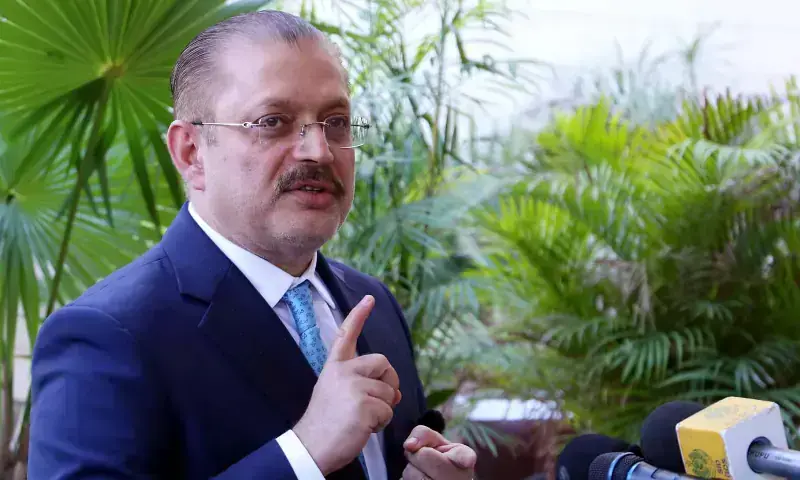
Sharjeel Memon says BRT Red Line 'very tough' project, asserts no delay from govt
Intelligence report synthesized for precision. Verified source updates below.
Detailed Report
Speaking to reporters in Karachi, Memon said the Sindh government had to make some difficult decisions on the BRT Red Line after “all other options were exhausted”.
The senior minister asserted that there had been “no mistake, mal-intent or delay” from the Sindh government on the BRT Red Line.
He noted that work on the project’s Lot-1 was “underway with great speed”, while work on Lot-2 had been restarted.
The Sindh government recently cancelled the construction contract for the BRT Red Line project. Subsequently, it chose the Frontier Works Organisation (FWO) to resume construction on a section of the BRT Red Line along University Road, where commuters have been facing inconvenience.
Designed to cover around 27 kilometres from Malir Halt to Numaish via University Road, work on BRT Red Line commenced in early 2022. While initially scheduled for completion by 2024, the project has faced persistent delays, with its finishing timeline most recently pushed to 2028.
A week ago, CM Murad, while “apologising” to the people of Karachi, announced that the deteriorated University Road will be reconstructed within 90 days.
In today’s media talk, Memon reiterated: “We will try that by the end of July, this road is opened for mixed traffic by working day and night, so that there is no nuisance for the public.”
“We realise the difficulty being faced by the public, but as they say, you have to swallow a bitter pill to achieve something big,” he remarked.
The minister recalled that the Sindh government approached the FWO for the reconstruction of University Road after “issuing warnings and clearing claims” of the contractors of the BRT Red Line project.
He noted that the government also took the Asian Development Bank (ADB) into confidence about the FWO’s involvement in the road reconstruction. While the BRT Red Line is an ADB-funded scheme, the reconstruction of the University Road will be undertaken as a separate project funded through the Sindh government’s own resources.
For the bus project itself, Memon said the government would follow up with the necessary legal actions, such as re-contracting or re-tendering.
The minister said it would have been “very easy” for the government to simply launch buses, such as the People’s Bus Service, but it decided to construct the BRT project for future generations, considering Karachi’s growing population.
Criticising certain political elements for “politicising” the BRT project, Memon said the government’s aim was to finish the project.
Meanwhile, Sindh Chief Minister Murad Ali Shah carried out an early morning inspection of BRT Red Line from Jail Chowrangi to Nipa, reviewing progress on mixed traffic lanes, drainage, asphalt work and traffic management.
“People’s hardship is unacceptable. Roads must be restored tonight, quality cannot be compromised and traffic flow must improve immediately,” he was quoted as saying by CM House, warning that he would continue surprise visits to monitor progress.
CM Murad directed all departments and contractors to accelerate work, restore roads on an emergency basis and ensure minimum inconvenience to citizens.
He also ordered the immediate commencement of the remaining work on the Red Line Mosamiyat Flyover so it could be opened for mixed traffic at the earliest.
The chief minister was accompanied by provincial ministers, Karachi Mayor Murtaza Wahab and project officials.
The Sindh CM also reviewed progress on Shahrah-i-Bhutto after inspecting the BRT Red Line project.
He was told that 38-kilometre Shahrah-i-Bhutto corridor, stretching from Jam Sadiq Interchange to M-9 Kathore Interchange, has reached 93 per cent completion.
The project is now targeted for completion by June 30, 2026, with efforts underway to open it to the public before Eidul Azha.
Murad termed Shahrah-i-Bhutto a “gift for people of Karachi”, asserting that it would play a key role in easing traffic congestion, shifting heavy traffic outside the city, and improving connectivity between M-9 and N-5 highways.
He also termed the project a “lifeline for Karachi’s economy”.