
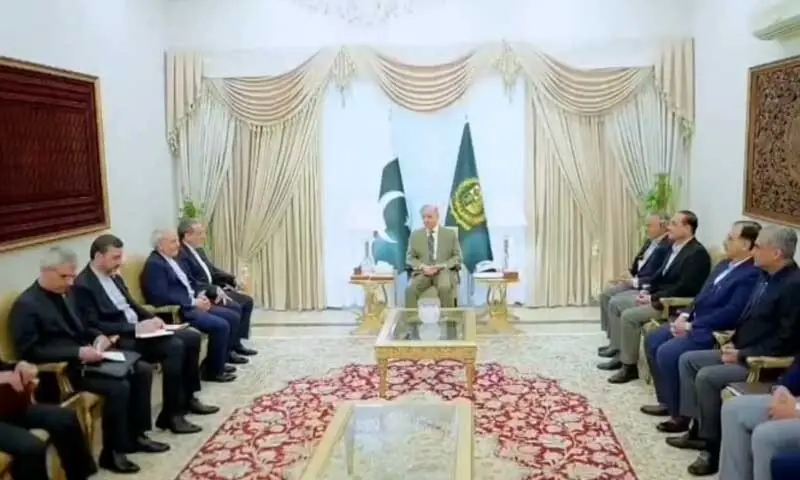
Iran's FM Araghchi meets PM Shehbaz, CDF Munir amid hopes for renewed US-Iran talks
Intelligence report synthesized for precision. Verified source updates below.
Detailed Report
“Regional developments and bilateral ties came under discussion,” state-run Pakistan TV reported about Aragchi’s meeting with the premier.
The Prime Minister’s Office, in a statement issued at the meeting’s beginning, said the two sides were set to discuss the “regional situation”.
CDF Munir, Deputy Prime Minister and Foreign Minister Ishaq Dar, and Iran’s Ambassador Reza Amiri Moghadam were also present during the meeting held at the Prime Minister House.
Earlier in the day, Araghchi held a separate meeting with CDF Munir.
“Matters of mutual interest and the overall regional situation were discussed,” state-run Pakistan TV reported about the meeting.
The Pakistani side included Interior Minister Mohsin Naqvi and other officials, while the Iranian delegation included Deputy Foreign Minister Kazem Gharibabadi, Ambassador Moghadam and Foreign Ministry Spokesperson Esmaeil Baqaei.
Araghchi arrived in Islamabad late on Friday — carrying Tehran’s formal response to proposals conveyed earlier by the US through Pakistan — as renewed diplomatic activity gathered pace. He was received by Deputy PM Dar and CDF Munir.
Ahead of the visit, he had held separate telephone conversations with Dar and Field Marshal Munir, focusing on the ceasefire and the diplomatic track.
The visit comes at a delicate moment in the US-Iran standoff, with a fragile, indefinitely extended ceasefire holding on paper, while core disputes over the naval blockade, nuclear restrictions and sequencing of concessions remain unresolved.
Pakistani officials said the Iranian minister’s trip was primarily aimed at conveying Tehran’s considered response after internal consultations.
“Purpose of my visits is to closely coordinate with our partners on bilateral matters and consult on regional developments. Our neighbours are our priority,” Araghchi said in a post on X before departing Tehran for his three-country tour, which also includes stops in Oman and Russia.
In his statement, Baqaei clarified, “No meeting is planned to take place between Iran and the US. Iran’s observations would be conveyed to Pakistan.”
He said Araghchi would meet with Pakistani “high-level officials in concert with their ongoing mediation and good offices for ending American-imposed war of aggression” and the restoration of peace in the region.
Araghchi reached Islamabad shortly after White House Press Secretary Karoline Leavitt said that US Special Envoy on the Middle East Steve Witkoff and US President Donald Trump’s adviser Jared Kushner would be leaving for Pakistan on Saturday for a second round of talks with Iran.
“I confirm special envoy Witkoff and Jared Kushner will be off to Pakistan again tomorrow morning to engage in talks — direct talks — intermediated by the Pakistanis, who have been incredible friends and mediators throughout this entire process, with representatives from the Iranian delegation,” she told Fox News.
“Everyone will be on standby to fly to Pakistan if necessary, but first, Steve and Jared will be going over there to report back to the president, the vice president and the rest of the team,” Leavitt said.
“The president, the vice president, the secretary of state, will be waiting here in the United States for updates, and the vice president, I understand, is on standby and will be willing to dispatch to Pakistan if we feel it’s a necessary use of his time,” she said.
“The Iranians reached out, as the president called on them to do, and asked for this in-person conversation,” she claimed.
“The president always wants to give diplomacy a chance. It’s always his first option, and he’s willing to do that here again,” Leavitt said.
She added that the US had seen some progress from the Iranian side in recent days and hoped more would be made in weekend talks.
The current phase of US-Iran negotiations follows the first round of direct talks held in Islamabad on April 11 and 12, which ended after more than 20 hours without agreement but kept the diplomatic channel open.
Since then, exchanges have continued indirectly through Pakistan, with both sides calibrating positions while avoiding a formal breakdown.
The ceasefire, originally brokered around April 7 and 8, has been extended without a defined timeline, creating space for diplomacy but also prolonging uncertainty.
Officials in Islamabad described the situation as fluid, with mediation efforts focused on bridging the sequencing gap between US demands and Iranian preconditions.