Trump rules out N-option amid Hormuz struggle
Intelligence report synthesized for precision. Verified source updates below.
Detailed Report
WASHINGTON: Backed by Republican allies in Congress, President Donald Trump on Thursday ordered the US Navy to target and destroy any vessel laying mines in the Strait of Hormuz, as US forces boarded a vessel transporting oil from Iran in the Indian Ocean.
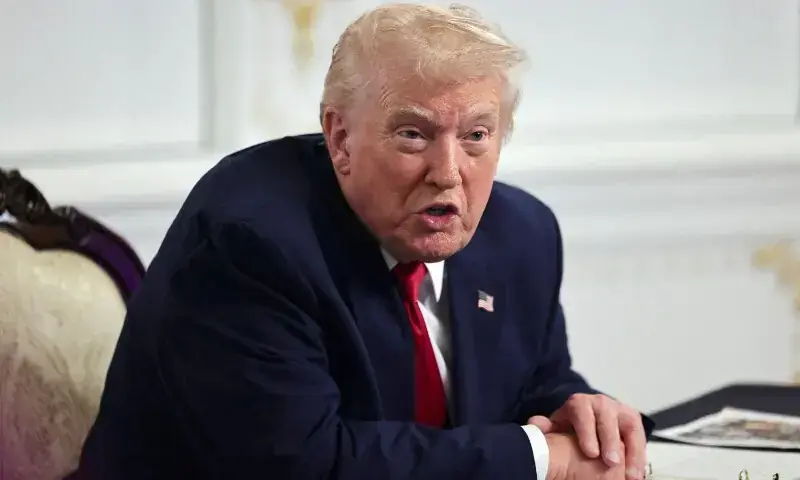
In subsequent remarks, he also ruled out the use of nuclear weapons against Iran, adding that while the US is in no rush to end the war, “the clock is ticking” for the Islamic republic.
Despite an indefinite extension in the ceasefire by the US, there has been no progress regarding the second round of peace talks between the two countries, with Tehran saying talks would not be possible amid a blockade of its ports.
The aircraft carrier USS George H.W. Bush has arrived in the Middle East, bringing the number of the massive American warships operating in the region to three.
A second carrier was operating in the Red Sea on Thursday, while a third is also in the region, according to social media posts by Centcom.
Meanwhile, Iran’s state news agency IRNA said the “sound of air defence firing” was heard in western Tehran, while the Mehr news agency reported that air defence systems were activated in several parts of the capital to counter “hostile targets”.
“We have total control over the Strait of Hormuz. No ship can enter or leave without the approval of the United States Navy. It is ‘sealed up tight’ until such time as Iran is able to make a deal,” he said.
On Wednesday evening, the Senate voted 46-51 against a motion to advance a war powers resolution from the Senate Foreign Relations Committee. The measure, sponsored by Senator Tammy Baldwin, sought to bar the administration from continuing hostilities beyond the timeframe allowed under US law.
The US Defence Department said its forces boarded the supertanker ‘The Majestic’ on Thursday, which was last reported off the coast of Sri Lanka carrying 2 million barrels of crude. The Pentagon announced on X that US forces had “carried out a maritime interdiction and right-of-visit boarding of the sanctioned stateless vessel M/T Majestic X transporting oil from Iran, in the Indian Ocean”.
US Central Command (Centcom) has redirected 33 vessels since the imposition of a naval blockade on Iranian ports. The US blockade has not halted Iran’s own use of the strait, according to data analytics firm Vortexa, which said about 10.7 million barrels of Iranian crude exports had left the area blockaded by the US Navy between April 13 and 21.
The firm said it recorded 34 movements of sanctioned and Iranian-linked tankers in and out of the Persian Gulf in the week amid the US blockade. The firm said it identified 19 outbound and 15 inbound movements of such vessels between April 13 and April 20. Six of those outbound movements were “confirmed laden with Iranian crude, representing about 10.7 million barrels”.
Meanwhile, Iran banked the first proceeds from the tolls it is exacting on shipping through the Strait of Hormuz, a senior official said. Iran’s deputy speaker Hamidreza Hajibabaei said Iran received its first revenue from tolls it is imposing on ships seeking to cross Hormuz. “The first revenue received from the Hormuz tolls was deposited into the Central Bank account,” said deputy speaker Hamidreza Hajibabaei.
Iran also flaunted its tightened grip over the Strait of Hormuz on Thursday with video of its commandos storming a huge cargo ship. State television broadcast footage overnight of masked troops pulling up in a grey speedboat alongside the MSC Francesca, climbing a rope ladder to a shell door in the hull and jumping through brandishing rifles. The footage also included views of another ship.
In the latest wartime shakeup at the Pentagon, John Phelan, a financier appointed by Trump as the navy secretary, was ousted late on Wednesday.
Phelan is the latest high-ranking military leader to leave the administration in recent months.
According to Pentagon spokesman Sean Parnell, Navy Undersecretary Hung Cao will serve on an acting basis in the role, which is largely administrative.
It comes just weeks after US Defence Secretary Pete Hegseth asked Army Chief of Staff Randy George to step down from his post.
Two other Army officials, Gen David Hodne and Maj Gen William Green, have also been removed from their roles recently.