Uncertainty prevails over Islamabad talks amid mixed signals from Iran
Intelligence report synthesized for precision. Verified source updates below.
Detailed Report
Iran’s foreign ministry spokesperson Esmaeil Baqaei said Tehran has yet to decide on whether to attend the next round of talks with the US.
His statement came after Iran’s parliament speaker Mohammad Bagher Ghalibaf said earlier today that Tehran was continuing negotiations with the US but remains ready to take “necessary measures” amid fears of renewed escalation.
The statements coming from Iran are reminiscent of Tehran’s stance ahead of the first round of Islamabad Talks, when Iran demanded that its “preconditions” be met in order for the dialogue to proceed.
Iran’s leaders were reiterating that stance even hours before the Iranian delegation landed in Pakistan, as a last-minute hurdle over Israeli strikes in Lebanon was eased.
Although a US delegation is expected to arrive in the capital tomorrow, according to US President Donald Trump, there is no confirmation so far that talks will be held.
The possibility has been cast in doubt after Trump said the US Navy had targeted an Iranian ship attempting to evade its blockade of the Strait of Hormuz, although both sides offered differing accounts of the incident.
Iran again closed the strait on Saturday, saying it would not reopen the maritime trade route until the US ended its blockade of Iranian ports.
Addressing a weekly press briefing in Tehran on Monday, Baqaei said, “As of now, while I am at your service, we have no plans for the next round of negotiation, and no decision has been made in this regard”.
The foreign ministry spokesman elaborated that the US was not serious about pursuing diplomacy, citing “violations” of their two-week ceasefire.
“While claiming diplomacy and readiness for negotiations, the US is carrying out behaviours that do not in any way indicate seriousness in pursuing a diplomatic process,” he said.
He highlighted that the US attack on the Iranian cargo ship early on Monday, the US naval blockade on Iranian ports, and delays in implementing a ceasefire in Lebanon were all “clear violations of the ceasefire”.
“Regarding the issue of transferring enriched uranium, neither during this period of negotiations nor before has transferring it to the United States been discussed,” Baqaei said.
“It was never raised as an option for us,” he added.
Separately, Ghalibaf, who led the Iranian delegation at the Islamabad Talks held on April 11 and 12, reiterated Tehran’s lack of trust in Washington.
“We do not trust the enemy. At any moment, it may escalate the war,” Ghalibaf said in televised remarks, according to Iran’s semi-official Mehr News Agency.
“We are negotiating, but we are prepared for the necessary measures,” said Ghalibaf.
He asserted that the ongoing conflict with the US and Israel began “through American deception in the middle of negotiations” and added that Iran had learned from the 12-day war in June 2025 and remained prepared for any future confrontation.
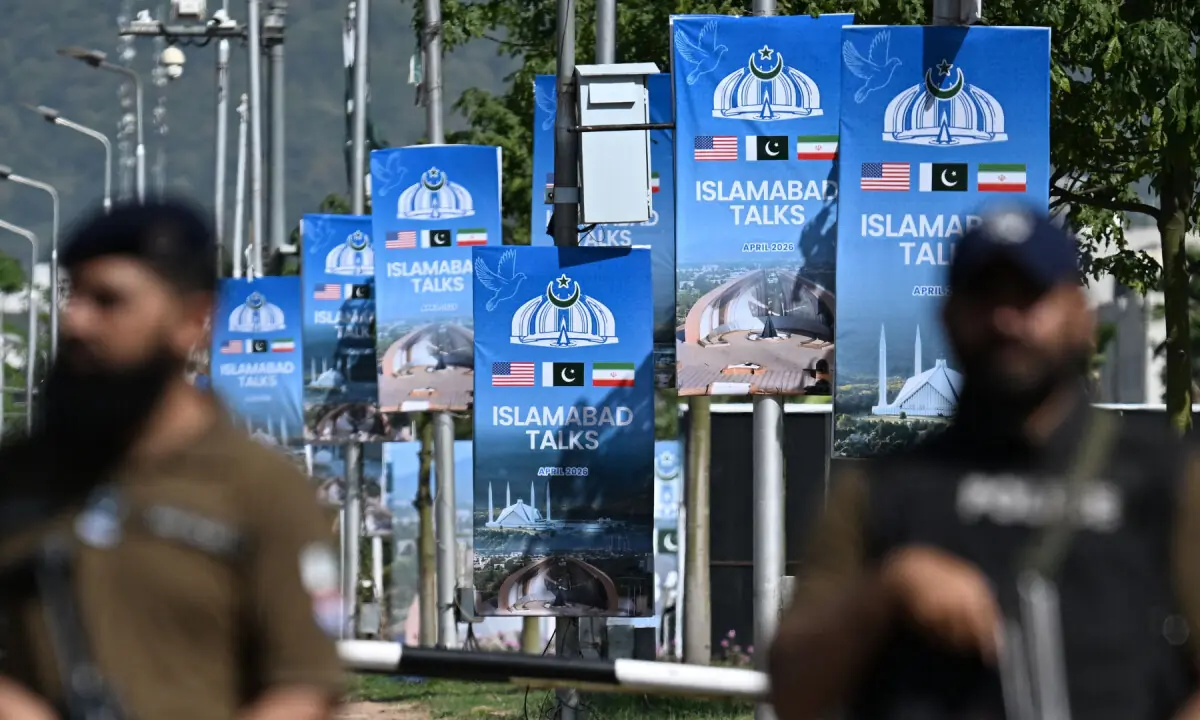
Meanwhile, Islamabad continues to set the stage for a possible second round of negotiations between Washington and Tehran.
Extraordinary security measures are in place in the federal capital and the garrison city, with reports that advance teams from the US for security arrangements arrived in Islamabad on Sunday.
A US Air Force Boeing C-17A Globemaster III aircraft prepares to land at the Nur Khan airbase in Rawalpindi on April 20, 2026. — AFP More than 10,000 security personnel, including commandos and snipers, had been deployed across Islamabad and Rawalpindi, besides separate arrangements at the Islamabad International Airport.
Authorities sealed the high-security Red Zone in the capital and other key routes, besides suspending public transport in the twin cities.
Two luxury hotels were also vacated for the expected guests.
“My Representatives are going to Islamabad, Pakistan — They will be there tomorrow evening, for Negotiations,” Trump posted on Truth Social on Sunday.
But it remained unclear who would head the US team.
During the first round of talks, US Vice President JD Vance led the delegation. But this time, there was no clarity whether he would be coming to Islamabad, particularly due to contradictory statements by the US administration.
Initially, Trump said his vice president would not lead the delegation “only because” of security concerns. “JD’s great,” he told ABC News. The White House quickly flipped the script when asked about those comments.
Iran’s First Vice President Mohammad Reza Aref also warned earlier in the day that security in the Strait of Hormuz cannot be guaranteed if Tehran’s oil exports remain restricted, referring to the US’s naval blockade of Iranian ports.
“No one can restrict Iran’s oil exports while expecting free security for others,” Aref said on X.
“The security of the Strait of Hormuz is not free,” he added.
Aref said the world faces a choice between “a free oil market for all” or “significant costs for everyone”.
He stressed that stability in global fuel prices depended on “a guaranteed and lasting end to the economic and military pressure against Iran and its allies”.