
'My daughter is under the rubble': Inside Tehran as civilian toll of strikes rises
Intelligence report synthesized for precision. Verified source updates below.
Detailed Report
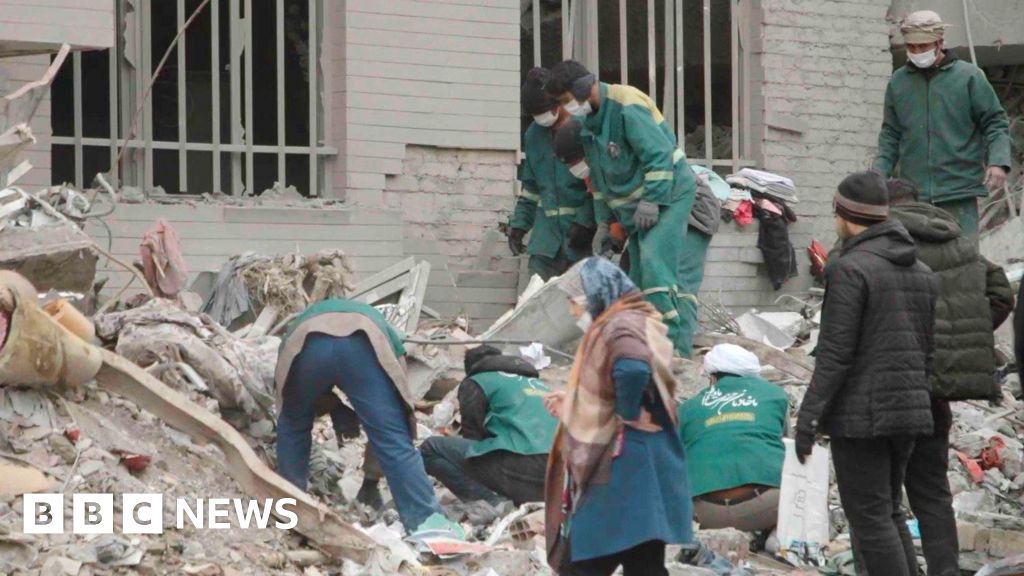
For days she has been waiting for rescue workers to dig through the flattened remains of what was once her daughter's flat in Resalat, a residential district in eastern Tehran.
"They don't have the manpower to get her out," the woman says.
"My daughter is under the rubble... she's afraid of the dark."
For a month, Iran has been at war with the US and Israel, which have been carrying out strikes across the country at targets linked to the regime.
But these attacks are also having a devastating impact on civilians living nearby.
They are now being caught between bombardment from the skies and a repressive regime that responded to anti-establishment protests with a deadly crackdown in January.
We've gathered eyewitness testimony, filmed the aftermath of strikes and analysed footage from social media and satellite imagery.
Our analysis shows there has been a series of attacks on state-linked targets that are embedded in civilian neighbourhoods in Tehran, with deadly consequences for those living around them.
Dozens of families had lived in the multi-storey apartment building in Resalat before it was destroyed by an Israeli air strike on 9 March.
The daughter trapped in the rubble had been living in the complex with her husband and own young daughter.
Days after the strike, she and her daughter were found dead under the rubble. The husband survived.
Another apartment building, across the road, was also destroyed in the air strike.
A man, 55, living in an apartment there, said the strike was "so sudden" and he was "thrown across the room".
He says everything he owns is now buried beneath the debris.
"I don't have anything now… All my documents, everything, it's gone."
Local authorities and residents say between 40 and 50 people were killed in this single attack.
Those made homeless are currently staying at a hotel nearby.
"This was our life," the man adds.
But analysis of the aftermath suggests the impact extended far beyond that single site.
Satellite imagery taken in the days after the strike shows at least four buildings destroyed in quick succession.
While one was well known to be associated with the Basij, surrounding structures appear to have been residential.
Residents also describe multiple explosions within seconds of each other.
"They hit three times," one survivor says.
"Maybe three or five seconds between them… I tried to stand up, but the rubble came down on my head."
They added that the scale and spread of the damage observed in Resalat is consistent with the use of the Mark 84, the largest of the series, weighing 2,000lb (907kg).
Unexploded bombs matching these types have been photographed in the city.
The UN has previously urged countries and armed groups at war to avoid using powerful bombs in highly populated areas because of the danger to civilian lives.
Resalat is not an isolated case.
Since the start of the conflict, the Israel Defense Forces said it had dropped more than 12,000 bombs across Iran and 3,600 bombs on Tehran alone.
US Central Command says it has struck more than 9,000 targets across Iran.
Many of these US and Israeli strikes have targeted police stations, Basij militia buildings, police headquarters, military and police universities, safe houses, Islamic Revolutionary Guard Corps (IRGC) homes, as well as potential ammunition stores and checkpoints.
Often, these targets are located within busy civilian neighbourhoods.
On 1 March, an Israeli strike hit the Abbasabad police station near Niloufar Square, where families had gathered after breaking their Ramadan fast.
Witnesses described a "terrifying light" followed by multiple explosions.
"We ran into the street," one man said.
"A man and a woman had just come out of a shop… they were hit immediately."
Residents reported multiple strikes in quick succession on the same target.
"It wasn't even two minutes," another witness said.
"When we came back, they hit again."
The IDF confirmed it was responsible for the attack, saying it "struck a military target".
Under international humanitarian law, all parties to a conflict must distinguish between civilian objects and military objectives.
The expected harm to civilians or civilian buildings must be proportionate to the expected military advantage gained from that particular action.
It also requires sides to avoid, as far as feasible, basing military targets within or near densely populated areas.
The US-based Human Rights Activists News Agency (HRANA) says that 1,464 civilians including at least 217 children have been killed in Iran in the first month of the conflict.
Iran has also struck civilian infrastructure and residential buildings in nearby countries during the war, such as airports and hotels, notably in Gulf nations allied with Washington.
In Tehran, residents criticised the Iranian authorities for their response to the war.
Several people we spoke to said they had received no guidance on where to go or how to protect themselves during attacks.
"There are no sirens, no warnings," one resident said. "You just hear the explosion."
In the absence of clear communication, and amid an ongoing internet blackout, many described feeling exposed and uncertain, unsure when or where the next strike might hit.
The Iranian government has not publicly detailed any nationwide civil defence protocols in response to the attacks.
The United States and Israel say they are targeting the infrastructure of the Iranian state.
But in a city where that infrastructure sits side-by-side with homes, shops and schools, the consequences are being felt far beyond the named targets.
For those living through it, that pressure is measured in homes lost, families shattered, and a growing sense that nowhere is truly safe.
The helicopter, which was carrying one pilot and four passengers,crash-landed about 100 yards off a beach, officials say.
Rex Heuermann, who is accused of murdering seven women, previously maintained his innocence and pleaded not guilty.
Why is it so hard to pass through the Strait of Hormuz?Paul Adams explains why it is so dangerous to navigate the strait, one of the world's busiest oil shipping channels.
The US television presenter will return to hosting the NBC news programme in April.
The strike - which killed at least 168 people, mostly children - "evoked a visceral horror", Volker Türk said.


