Inside the alleged Russian operation to trigger anti-government protests in Angola
Intelligence report synthesized for precision. Verified source updates below.
Detailed Report
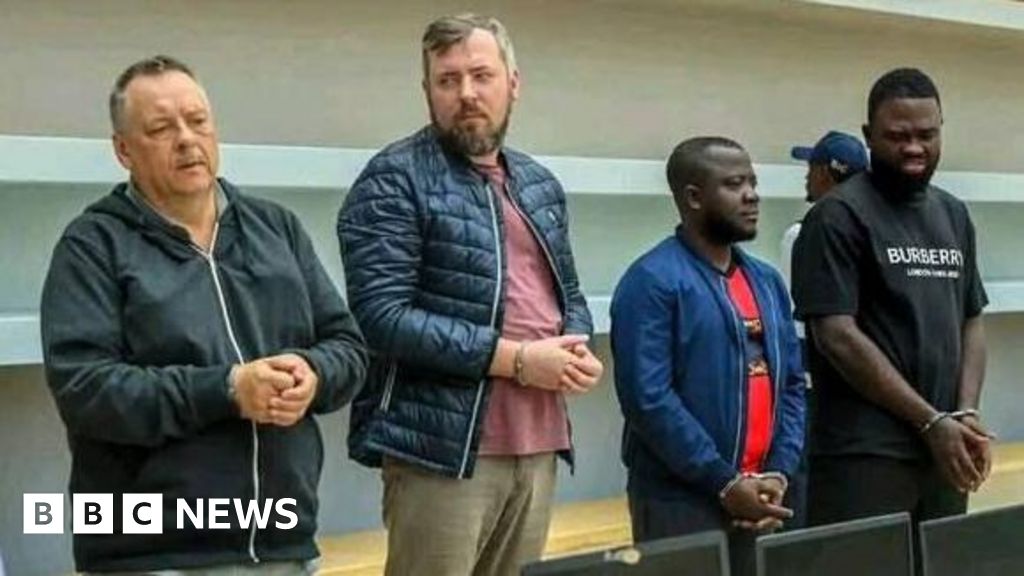
Arrested last August, political consultant Igor Ratchin and translator Lev Lakshtanov are facing 11 charges, including terrorism, espionage and influence peddling.
The Russians' lawyers challenge the indictment on the grounds that it lacks "concrete and objective facts".
According to the prosecution, the Russians acted on behalf of Africa Politology, a shadowy network of operatives and intelligence officers in Africa that emerged from the now-defunct Wagner Group, whose founder Yevgeny Prigozhin died in 2023 in a plane crash.
Political operatives linked to Wagner have been active across Africa for more than a decade, in particular in the Central African Republic, Mali, and Madagascar.
The Russians' defence team says they are not connected to Africa Politology or the Wagner Group, were not acting on behalf of the Russian state, and were instead cooperating to create a cultural "Russian House" in Luanda.
Angola is a top African oil producer and diamond exporter. Its natural resources and strategic position make it a country of continued interest for Moscow. But while ties date back to the Cold War, Angola has been gradually drifting away from Russia's sphere of influence.
Russian diamond mining company Alrosa and bank VTB were forced to leave Angola due to international sanctions imposed because of the Ukraine war.
Angolan President João Lourenço has pivoted towards the West, and has not met his Russian counterpart Vladimir Putin since 2019.
The Russian operatives in Africa were breaking new ground by moving into Angola, it is claimed.
"This is indicative of Russian anxiety of the direction of travel of Angola under the Lourenço administration," says Alex Vines, Africa programme director at think-tank European Council on Foreign Relations.
"There's clearly an element of Russian disinformation to try and build up more sympathy towards the Russian Federation."
Alongside the Russians, two Angolans will also face trial for their alleged part in the Russian-linked influence operation.
The prosecution alleges the Russians hired sports journalist Amor Carlos Tomé and political activist Francisco Oliveira to conduct their activities in the country.
They are facing nine and five charges respectively, including terrorism, espionage, and influence peddling.
The legal team representing the Angolan defendants say there isn't sufficient evidence against them and that "the accusation is based on mere conjecture".
Prosecutors say the first team of Russian operatives arrived in Angola's capital, Luanda, in 2024 under the pretext of opening a Russian cultural centre, a project that never materialised.
Among the initial arrivals was Maxim Shugalei, a prominent Wagner-linked political operative sanctioned by the European Union (EU) for overseeing disinformation campaigns, whose activities in Africa were turned into a film trilogy, seemingly sponsored by Prigozhin.
While Suaifan has acknowledged being acquainted with the defendants, Shugalei has denied knowing them.
According to the indictment, during 2024-2025 the defendants made multiple payments to local journalists and experts to disseminate propaganda and disinformation in local media with the goal of "provoking political change". The payments add up to over $24,000 (£17,900).
Angolan authorities see this work as part of a broader influence operation intended to undermine trust in Western partners and discredit President Lourenço's foreign policy.
One insider, who previously worked with Prigozhin on African projects, criticised these efforts as amateurish.
The prosecution cites some publications as evidence of the disinformation campaign carried out by the two Russian men.
In December 2024 a post on the same page criticised the Lobito Corridor, a Western-backed rail project, which moves minerals from central Africa to Angola's ports.
The post about the Lobito Corridor appeared on news website Lil Pasta News a day later. Another article published by the website speculated whether the country had "signed a pact with the Devil" by joining the project.
The lawyers representing the Russian defendants argue that there is no evidence to suggest that Ratchin commissioned any of the articles.
Angolan prosecutors portray the group as a small but effective network. Ratchin was allegedly at its centre.
Lakshtanov has worked as a translator in Angola since the Soviet era. Prosecutors believe he played a supporting role in the operation, acting primarily as a translator.
The local connection was supposedly provided by Francisco "Buka Tanda" Oliveira, a youth leader for Angola's main opposition party, Unita, who speaks Russian after having studied chemical engineering in Russia between 2015 and 2019.
The prosecution claims he was tasked with introducing Angolan politicians to the defendants.
"He [Oliveira] doesn't know this organisation [Politology] and any activity related to this organisation. All he knows is that they wanted to create Russian culture house," says defence lawyer Pedro Cangombe.
Tomé, a sports journalist at Angolan state TV channel TPA, is accused of gathering information on the country's political landscape and potential presidential candidates, as well as helping to produce and publish content linked to the alleged influence operation.
The defence for Tomé argues that "none of the subjective or objective elements" of crimes are "minimally" demonstrated in the indictment.
The indictment names six more Russian members of the network who allegedly rotated in and out of Angola at various times in 2024 and 2025.
Angolan authorities also claim in the indictment that Lakshtanov and Ratchin met several senior political figures from both the ruling MPLA party and Unita, offering support and funding for campaign activities.
Most notably, the prosecution alleges they held a meeting with MPLA heavyweight General Higino Carneiro and Unita's leader Adalberto Costa Junior.
Both are regarded as potential presidential candidates for next year's election.
Prosecutors claim the Russians offered Carneiro up to $15m (£11m) in campaign support, alongside security assistance, strategic advice, and intelligence gathering.
There was no evidence about this alleged offer in the indictment we have seen.
"I don't know whether such a meeting took place," says Elizeu Nguiniti, the lawyer representing Ratchin and Lakshtanov.
Last July, Angola saw the deadliest protests since the end of a civil war between Unita and the MPLA in 2002.
What started as a peaceful taxi drivers' strike in Luanda quickly grew into nationwide unrest that turned violent.
Protesters were met with what activists describe as "excessive" police force.
According to official figures, at least 29 people died and more than 1,200 were arrested.
The prosecution alleges the defendants orchestrated the protests, pointing to notes about the demonstrations found on their mobile phones and photos taken by Ratchin.
Many Angolan journalists and activists strongly contest the idea that the protests weren't organic, and say Angolan authorities might be using the Russians as scapegoats.
The World Bank estimates that almost 40% of Angolans could be living below the international poverty line of $3 per day.
"People were protesting because of their living conditions, not because someone from another country told them to," says Sheila Nhancale, Angola researcher at Human Rights Watch.
The indictment itself has been criticised. It contains misspellings and apparent factual errors.
For example, prosecutors say the Russian operation began on 9 October 2024 with the arrival of Maxim Shugalei and others, but Shugalei was arrested in Chad on 19 September 2024 and returned to Moscow in 16 November 2024.
Rui Verde, a legal expert and a research associate at the UK-based University of Oxford's African Studies Centre, says the key challenge for the prosecution will be to show that the acts listed in the indictment form a deliberate pattern, a kind of intentional roadmap to subversion.
According to several sources, the Russians could be sent back to their homeland if convicted.
But Russian authorities do not seem in a hurry to offer help.
"Let these remnants of Prigozhin's operation sort it out themselves," the source said.
The reported disappearance of Raphael Tuju had led to claims he may have been abducted.
The videos sparked widespread anger, leading to the hashtag #StopRapingWomen to trend on social media.
The strike killed 64 people, including 13 children, two nurses and a doctor, according to the WHO head.
How a lack of justice and trust in the security forces perpetuates deadly violence in Plateau state.
Saadia Mosbah campaigned for migrants, particularly after President Kais Saied said they posed a demographic threat to the country.