
Louisiana firefighters find feline native to sub-Saharan Africa while responding to house fire
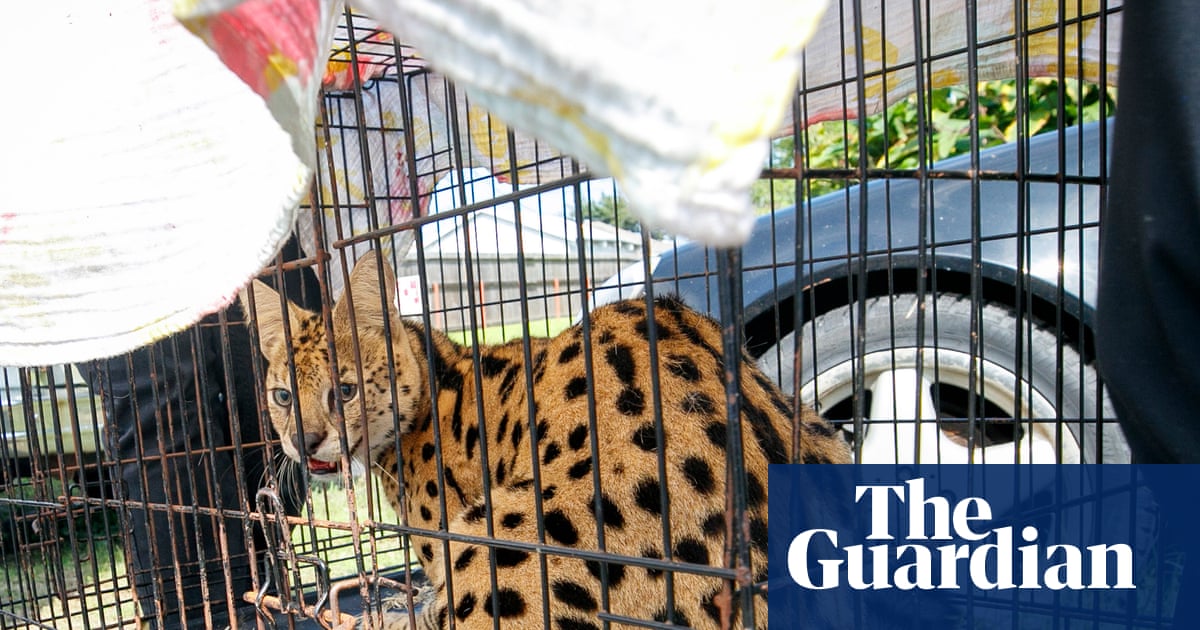
An African serval in a transport carrier after being found in the back yard of a home by firefighters in New Orleans. Photograph: John McCusker, JPawsView image in fullscreenAn African serval in a transport carrier after being found in the back yard of a home by firefighters in New Orleans. Photograph: John McCusker, JPawsLouisianaLouisiana firefighters find feline native to sub-Saharan Africa while responding to house fireThe African serval, illegally enclosed in the back yard, was subdued and transferred to an animal welfare facility
Prefer the Guardian on GoogleLouisiana firefighters responding to a small house blaze found a wildcat native to sub-Saharan Africa illegally enclosed in the back yard, and an animal welfare agency is now seeking to place the creature in an appropriate environment, according to officials.
Firefighters investigating a report of a minor fire at a home in the suburban New Orleans community of Marrero on Tuesday spotted the cat in question – an African serval – behind the residence in a chain-linked enclosure resembling a cramped baseball batting cage, a spokesperson for the local animal protection services said.
A statement from Jefferson protection and animal welfare services (JPaws) said its director, Michelle Brignac, and humane department supervisor, Victoria Clark, joined firefighters at the scene after they were summoned there. Local laws require an exotic animal permit to legally keep a serval as a pet, and the owner of the home at the center of the case did not have such a document, JPaws spokesperson John McCusker told the Guardian on Thursday.
View image in fullscreenAn African serval cat being transported after being found in an enclosure in the back yard a of a home. Photograph: John McCusker, JPawsThe statement said Brignac and Clark therefore “subdued the hissing serval and wrangled it” into a transport carrier from its 9ft-by-9ft (7.53-sq-meter) cage that McCusker likened to “a dog kennel”. Brignac and Clark then brought the serval to the JPaws facility in the nearby community of Harvey, according to the statement from the agency, which also shared vivid photographs of the wildcat.
Beside their black spots, svelte physiques and striking facial features, servals are known for their ability to leap as high as about 7ft (2 meters) in the air. So McCusker said JPaws gave the serval an entire room to itself while the agency sought an appropriate refuge for the wildcat, which was born in captivity but whose natural habitat is African grasslands.
Servals share some similarities with domesticated cats that make them immensely popular as pets, including their affinities for grooming themselves, purring, yowling and stalking potential prey.
Nonetheless, they are not easily sustained pets, JPaws’ statement maintained. Servals in captivity do not have the physical space and stimulation needed to engage in normal, healthy behaviors, and they endure chronic stress as a result, the agency’s statement said.
They mark their territory, become aggressive as they mature, cannot be fully house-trained and destroy furniture, and they have been known to barge through walls and doors, according to JPaws. Experts also say servals require a diet and specialized care beyond what house cats need, making them a major responsibility.
JPaws’ statement said the agency would explore having the serval held temporarily at New Orleans’ Audubon zoo. A zoo spokesperson, however, said the institution did not plan to take the serval in and understood JPaws was looking into another arrangement, the details of which were not immediately available on Thursday.
The Marrero serval was the latest of several indicators of the wildcats’ growing popularity, a boom driven in part by social media content creators showing them in videos online.
View image in fullscreenServals mark their territory, become aggressive as they mature and cannot be fully house-trained. Photograph: John Mccusker/John McCusker, JPawsCases involving servals have also tended to generate widely read news headlines in North America.
That happened in Ohio in 2023, when officials in the Cincinnati area captured an African serval named Amiry that was spotted in a Cincinnati neighborhood tree and later tested positive for cocaine.
In late 2025, a search for an African serval that escaped a Pennsylvania wildlife center culminated in heartbreak after a motorist fatally struck the wildcat, as Philadelphia’s NBC News affiliated reported.
View image in fullscreenThe Marrero serval was the latest of several indicators of the wildcats’ growing popularity. Photograph: John Mccusker/John McCusker, JPawsAnd the news outlet People reported on authorities in the Canadian city of Vancouver returning an African serval to its owners after it escaped and nestled under a neighbor’s porch in June.
The British Columbia province to which Vancouver belongs had just banned keeping exotic cats such as African servals as pets. But, People reported, the owners of such cats were given until the beginning of May 2027 to apply for permits to legally possess them.
Quik News synthesizes verified facts across international press reporting. Original reporting belongs to the attributed outlets above.